
2025: encouraged
“Boards are encouraged to take an integrated approach to curriculum and financial planning.”Read section 2.13 in the 2025 Handbook
Academy Trust Handbook 2026
Connect the curriculum you want to deliver with the people and budget it needs. ICFP.school helps you understand today’s position and plan for the years ahead.
Request a tailored ICFP walkthroughEffective from 1 October 2026 Academy trusts in England
Where do we need to look more closely?
What does this mean for the years ahead?
What has changed?
The change in section 2.13 strengthens the position on integrated curriculum and financial planning. The wording matters.
“Boards are encouraged to take an integrated approach to curriculum and financial planning.”Read section 2.13 in the 2025 Handbook
“Boards should take an integrated approach to curriculum and financial planning in their schools.”Read section 2.13 in the 2026 Handbook
The Handbook defines “should” as minimum good practice. Trusts should apply it unless they can demonstrate that another approach better suits their circumstances. It is different from “must”, which identifies a requirement.
The Handbook does not require trusts to buy ICFP software. ICFP.school offers a practical way to support the planning process. Your board retains responsibility for its decisions. Read the DfE explanation.
Planning with ICFP.school
Your budget tells you what you expect to spend. ICFP helps you ask why, how that spending supports the curriculum and what may need to change. ICFP.school puts curriculum metrics, expenditure and forecasts in the same workspace.
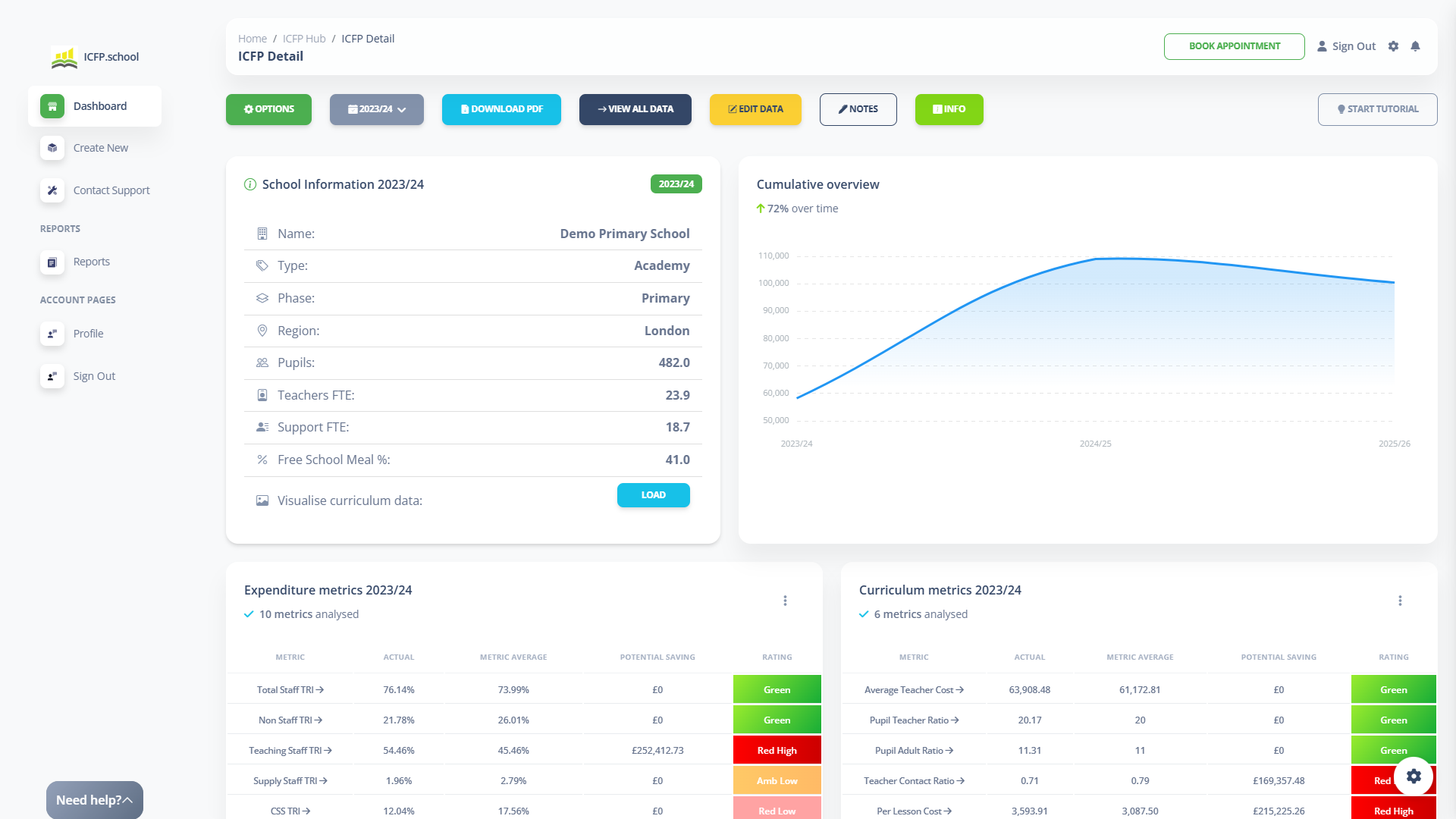
Use school, staffing, curriculum and financial information to build your ICFP picture. Review expenditure alongside pupil numbers and deployment, with a common set of assumptions for finance and education leaders.
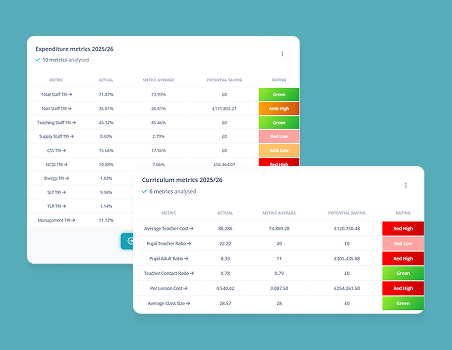
Read curriculum and expenditure metrics together, compare years and examine relevant benchmarks. Ratings and opportunity indicators help focus the discussion. They need to be interpreted in the context of your provision.
Use forecasts to explore the outlook beyond the current year. Core includes a five year forecast; Premium adds full expenditure budget forecast generation and detailed metric dashboards.
Reading the metrics together
A high staffing cost is a starting point for investigation. Is the pressure coming from the cost of each teacher, the number of teachers relative to pupils, or how teaching time is deployed?
Reading these measures together helps you explore the cause before discussing a response. It also gives curriculum and finance colleagues a more useful starting point than a single spending percentage.
| Metric | What it tells you | The planning question |
|---|---|---|
| Staff expenditure as a share of income | The proportion of revenue income spent on staffing. | How much of our income is committed to people, and what remains for other priorities? |
| Average teacher cost | The average cost of a full time equivalent teacher. | How does the cost of our staffing structure affect the curriculum we can provide? |
| Pupil teacher ratio | The number of pupils relative to full time equivalent teachers. | How does our level of staffing relate to pupil numbers and the provision we need? |
| Teacher contact ratio | The proportion of available teaching time allocated to teaching. | How are teaching, leadership, preparation and other responsibilities reflected in deployment? |
A benchmark is a comparison, not a target for every school. Phase, pupil need, curriculum choices and organisational context all matter. Explore the curriculum element of ICFP.
The questions behind the plan
ICFP is useful when it helps you understand a choice. Explore how curriculum and financial information can inform three common planning conversations.
These are examples of a planning approach, not calculated results or recommendations for your school.
How ICFP goes beyond benchmarkingA smaller intake can change income before your staffing commitments change. Looking at the budget alone can miss what that means for class organisation and curriculum provision.
Review pupil numbers alongside the pupil teacher ratio, average class size and your financial forecast. Check which assumptions are changing and which costs are likely to stay in place.
Pupil teacher ratio · Average class size · Forecast
Use the results to discuss whether the planned curriculum remains affordable, what needs closer investigation and when a staffing decision may be needed.
A higher staffing bill could reflect pay, the experience of your team, deployment, supply cover or a combination of these. Each calls for a different conversation.
Read staff expenditure as a share of income alongside average teacher cost and teacher contact ratio. ICFP.school brings expenditure and curriculum metrics together so you can investigate the pattern.
Staff expenditure · Average teacher cost · Teacher contact ratio
Discuss the reasons with curriculum and finance colleagues before deciding on an action. A metric can identify a question; your knowledge of provision and staff explains the answer.
The same financial result can have very different causes in schools with different phases, pupil profiles and curriculum models. A trust average is only a starting point.
Premium combines an overview across schools with detailed metrics and bespoke comparison datasets. Look at the variation, then select relevant comparators and explore the context of each school.
Premium: trust overview · Relevant comparators · Detailed metrics
Use that evidence to focus conversations with school leaders, agree where support would help and prepare a clearer explanation for trustees. PDF and Excel exports are included in Premium.
ICFP.school Premium
An overview across schools helps a central team decide where to begin. Premium brings together aggregated dashboards for trusts and local authorities, detailed metrics and bespoke comparison datasets so you can investigate the variation behind the overall result.
Choose comparators by factors such as phase, region and pupil profile. Use PDF and Excel exports to bring the analysis into discussions with school leaders and the board, supported by your explanation of the assumptions and decisions.
Compare tiers and pricing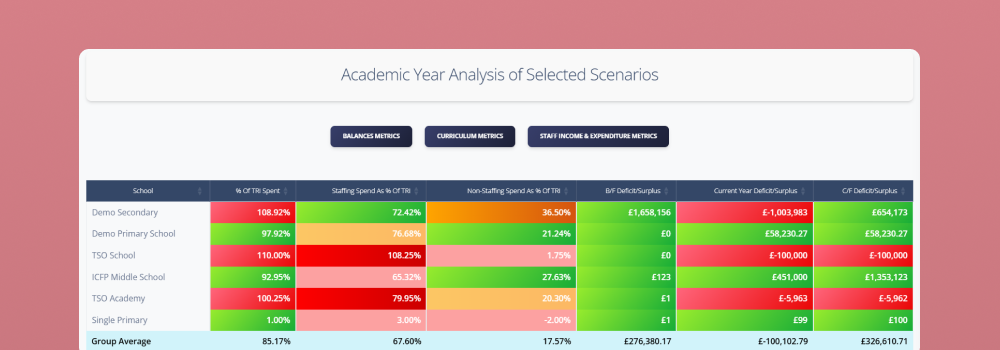
Appointments with ICFP experts give you space to discuss your findings and planning questions. SBL Chat also lets you explore your ICFP context through an AI assistant, alongside professional judgement.
Premium includes custom upload templates and a service to upload your data for you. We will explain the information needed and agree the next steps for your organisation.
Your next step
Tell us about your organisation and the decisions you are working through. We will reply within one working day to arrange a walkthrough or send the further information you need.
Tell us a little about your organisation. We will reply within one working day.
Questions before you begin
Section 2.13 of the 2026 Handbook uses “should”, which identifies minimum good practice, rather than “must”. It strengthens the expectation that boards integrate curriculum and financial planning. The official Handbook explains how trusts should apply that distinction.
We will focus on the planning questions you share with us. That may include curriculum and expenditure metrics, forecasts, comparisons across schools or Premium reporting and expert support. We will explain which tier includes each feature.
Yes. Premium includes aggregated dashboards for trusts and local authorities, helping leaders compare metrics and identify areas for discussion across schools. Tell us the number of schools and your role so we can tailor the conversation.
ICFP.school supports the analysis behind your planning. You remain responsible for the quality of your assumptions, your curriculum choices and your financial decisions. Benchmarks and suggested opportunities need to be considered in your school’s context.
For more context, read the DfE guidance on ICFP, our explanation of the curriculum element of ICFP and our article on ICFP in academy trusts.
Handbook sources checked on 7 September 2026. ICFP.school is provided by TSO Education LTD and is independent of the Department for Education.